
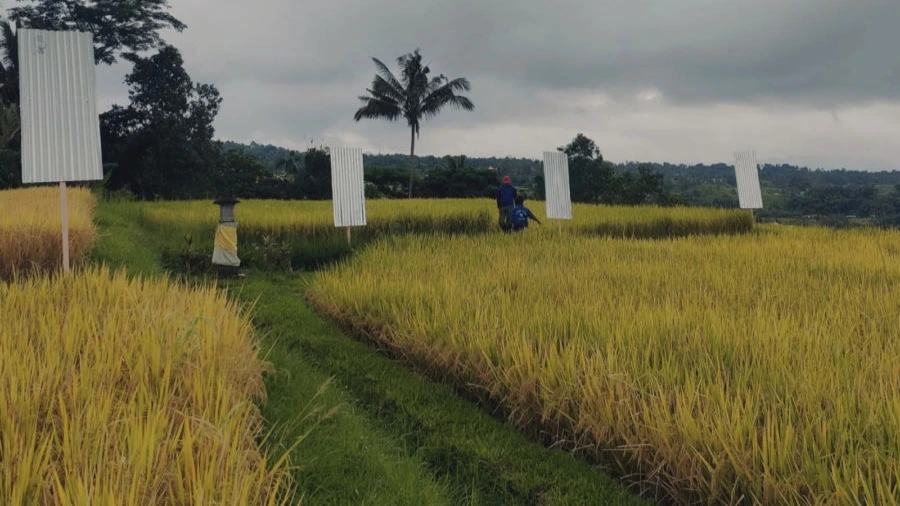
TABANAN, DEWATA.NEWS – The installation of metal sheets across several rice field sections in Jatiluwih has begun to affect visitor numbers at the UNESCO-listed cultural landscape. Management of the Jatiluwih Tourist Attraction (DTW) reported that more than a dozen travel agents have canceled scheduled visits in recent days, fearing potential demonstrations or disruptions in the area.
I Ketut Purna, Operations Manager of DTW Jatiluwih, said that cancellations started immediately after farmers and building owners put up metal sheets as a form of protest against recent enforcement actions targeting 13 structures deemed to have violated land-use regulations.
“Since this morning, many freelance guides and travel agents have canceled their visits. More than ten agents informed us today alone. They assumed there was a protest happening,” Purna said on Friday (5 December).
Purna known locally as Jhon, explained that the management will formally notify the governing body overseeing Jatiluwih so the situation can be resolved quickly. He emphasized that the installation of the metal sheets was outside the operational authority of DTW. However, management is preparing reports and a draft letter urging faster intervention to safeguard tourism flows.
“I will send a letter to the management board to ensure this issue receives serious attention. Our job is to maintain tourism, to make sure guests come and continue to return,” he said.
Support Programs for Farmers Continue
Responding to questions about DTW’s contributions to local farmers, Jhon outlined several ongoing support initiatives. These include distribution of free seeds and urea fertilizer based on subak needs, as well as financial support such as IDR 30 million per tempek for the annual ngusaba ceremony and IDR 7 million for ngusaba alit.
Starting December 2025, DTW plans to introduce a land preparation subsidy of IDR 2.5 million per hectare (IDR 25,000 per are) to help farmers at the beginning of each planting cycle.
Since May 2025, operational assistance of IDR 2 million per month has also been provided to Tempek Besi Kalung, while tempek outside the core zone receive IDR 750,000 per month under DTW’s CSR program.
Management is currently waiting for a meeting schedule with seven tempek in the Jatiluwih area: Telabah Gede, Besi Kalung, Uma Dwi, Gunung Sari, Uma Kayu, Kesambi, and Kedamian.
Clarifying Rules on Rice Field Structures
Purna also addressed confusion regarding which types of structures are permitted in the rice fields. Under previous administrations, farmers were allowed to build simple 3×6 meter huts to rest, eat, store tools, or shelter livestock.
If such huts are now used to sell local products, they remain acceptable as long as they retain the traditional “field hut” or cattle shed form and do not resemble permanent buildings.
However, he reminded the community that extensive new construction in the rice fields is not allowed, as it risks undermining the UNESCO World Heritage status.
“If we continue allowing large-scale development in the fields, the long-term impact could be serious. We do not want UNESCO to leave us. We want this heritage to remain sustainable for future generations,” he stressed.