
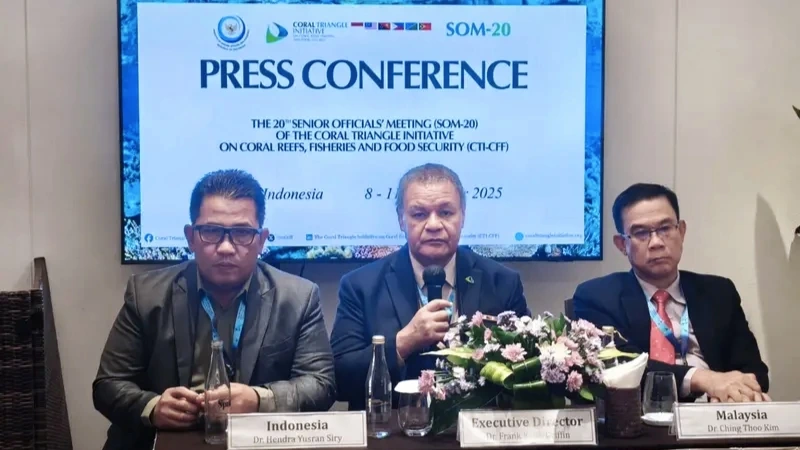
DENPASAR, DEWATA.NEWS – The 20th Senior Officials’ Meeting (SOM-20) of the Coral Triangle Initiative on Coral Reefs, Fisheries, and Food Security (CTI-CFF) has officially opened in Bali, marking a key moment for advancing regional cooperation in marine conservation, sustainable fisheries management, and climate resilience across the Coral Triangle.
Senior representatives from the six CTI-CFF member countries, Indonesia, Malaysia, Papua New Guinea, the Philippines, Solomon Islands, and Timor-Leste, gathered to review program progress, finalize the 2026 work plan, and outline future priorities for the initiative.
The forum is co-organized by the CTI-CFF Regional Secretariat and the Government of Indonesia through the Ministry of Marine Affairs and Fisheries (KKP), serving as the National Coordinating Committee.
SOM-20 is being held on 10–11 December 2025, following a two-day Pre-SOM session on 8–9 December. The Pre-SOM allowed senior officials and technical working groups to discuss partner engagement, technical reports, and governance reforms to ensure that recommendations brought to SOM-20 are robust, data-driven, and actionable.
Reinforcing Member Country Commitments
During the main session, delegates reviewed progress across several working groups, including Seascape, Ecosystem Approach to Fisheries Management (EAFM), Marine Protected Areas (MPA), Climate Change Adaptation (CCA), and the Threatened Species Working Group.
Cross-sector collaboration was also highlighted through initiatives such as the Women Leaders Forum, University Partnership, Regional Business Forum, and governance groups including FRWG, MEWG, and IRC.
Koswara, Director General of Marine Spatial Management at KKP and Chair of the CTI-CFF Committee of Senior Officials (CSO), underscored the importance of sustained regional alignment.
“SOM-20 reflects the ongoing commitment of member countries to strengthen science-based cooperation for sustainable fisheries, resilient marine ecosystems, and food security for coastal communities in the Coral Triangle region,” he said.
Malaysia’s CSO Vice Chair, Datuk Dr. Ching Thoo a/l Kim, highlighted the value of shared leadership. “The discussions at SOM-20 demonstrate the importance of coordinated regional leadership. By exchanging best practices and technical insights, we ensure sustainable management of the Coral Triangle’s resources for future generations,” he noted.
Key Outcomes of SOM-20
The meeting produced seven major decisions, including:
- Endorsement of the SOM-20 Chair’s Report summarizing achievements and collective priorities.
- Presentation of 2025 country reports from all six member nations.
- Approval of governance recommendations from MEWG, FRWG, and IRC to strengthen accountability and financial management.
- Adoption of the 2026 work plans and budgets for technical working groups, covering seascapes, ecosystem-based fisheries, conservation areas, climate adaptation, and threatened species protection.
- Acceptance of the Executive Director’s report outlining progress and priorities for the upcoming year.
- Appreciation for CTI-CFF partners for their contributions to regional collaboration.
- Endorsement of the SOM-20 Chair’s Summary as the guiding reference for 2026 program implementation.
Hendra Yusran Siry, Indonesia’s Head Delegate and Senior Advisor to the Minister of Marine Affairs and Fisheries, stressed the importance of collective stewardship.
“Indonesia ensures that every SOM-20 decision aligns with efforts to strengthen marine ecosystem health and fisheries management at both national and regional levels,” he affirmed.
CTI-CFF Regional Secretariat Executive Director Dr. Frank Griffin praised the consultative process leading up to SOM-20.
“This meeting provides a vital space to review progress and align priorities. Member countries have contributed actively across governance, technical, and cross-sector agendas, shaping a strong work plan for the year ahead,” he said.
The CTI-CFF Regional Secretariat and KKP reiterated their commitment to supporting member nations in implementing SOM-20 decisions to accelerate sustainable development, climate resilience, and marine resource protection across the Coral Triangle.