
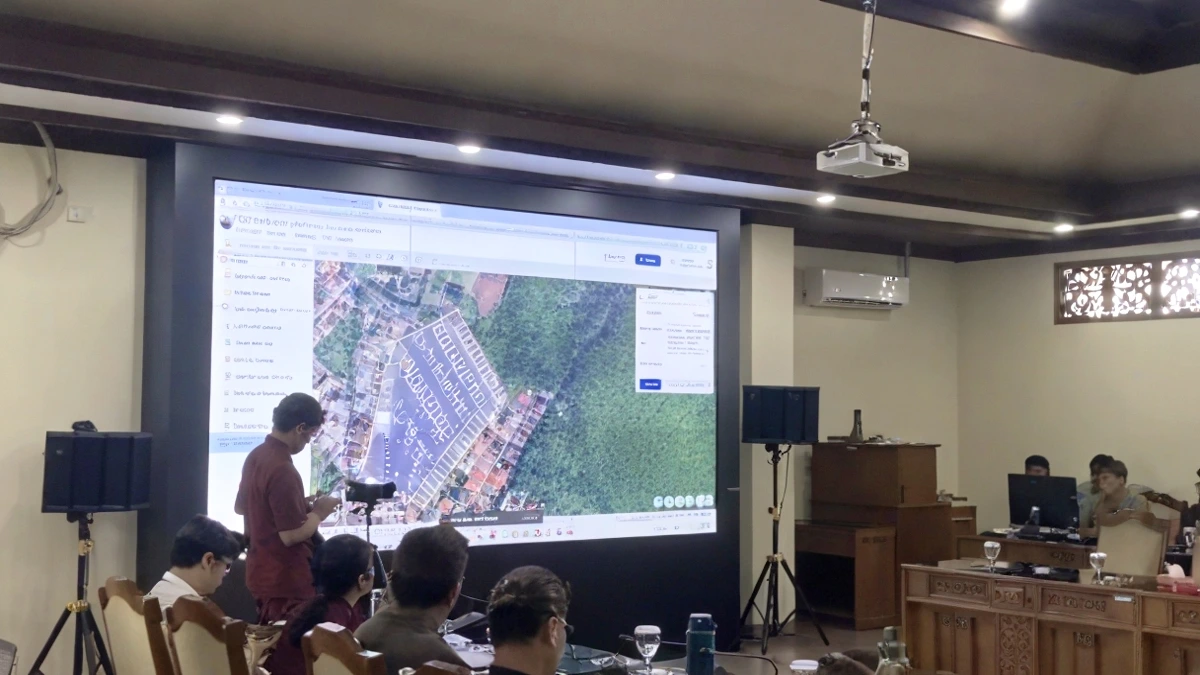
DENPASAR, DEWATA.NEWS – Bali Provincial lawmakers have held a formal hearing to further examine alleged spatial planning and licensing violations involving several buildings and business activities located within the Ngurah Rai Grand Forest Park (Tahura) conservation area.
The hearing was conducted during a meeting of the Special Committee on the Enforcement of Regional Regulations on Spatial Planning, Regional Assets, and Licensing (Pansus TRAP) of the Bali Provincial House of Representatives (DPRD). The session took place at the DPRD Bali building in Denpasar on Thursday (29 January).
A number of businesses operating within or adjacent to the Tahura area were summoned for clarification, including Bali Siki Housing Management, Kampung Kepiting, Mooncat Turtle Conservation, Mall Bali Galeria, Harvest Land Jimbaran, Wijaya Berlian Residence, and PT Anugerah Sarana Propertindo.
The meeting was chaired by Pansus TRAP head I Made Supartha, accompanied by committee members and secretariat representatives. During the session, Supartha emphasized that mangrove areas are permanent conservation zones that cannot be converted for other uses.
“Mangrove areas are protected and conserved by law. Their status is permanent and they must not be repurposed,” he said.
He explained that mangrove protection is regulated under multiple legal frameworks, including provincial regulations and national laws governing coastal areas, spatial planning, and environmental protection. According to Supartha, these laws clearly prohibit activities that damage or alter mangrove ecosystems.
Supartha also highlighted the ecological importance of mangroves, noting their role in carbon absorption, oxygen production, habitat protection, and coastal defense against natural disasters such as flooding and tsunamis.
“One hectare of mangrove forest can absorb nearly 400 tons of carbon. This is why mangroves are considered permanent conservation areas, and no activity should damage or convert them,” he said.
The Ngurah Rai Tahura area, covering approximately 1,373.5 hectares, was described as one of Bali’s last remaining protected zones. Supartha stressed that the area must not be certified, reclaimed, compacted, or subjected to other forms of development.
“This area must not be certified or reclaimed. Any form of land alteration is prohibited by law, and it is our collective responsibility to protect it,” he stated.
According to the committee, the current review focuses on zones where mangrove forests, the Tahura conservation area, and development activities intersect, particularly in parts of Denpasar and Badung. The investigation aims to prevent any illegal conversion of protected mangrove land.
“We want to ensure there are no violations. These overlapping areas will be examined thoroughly to safeguard the mangrove ecosystem,” Supartha added.
Meanwhile, Badung Regional House of Representatives Commission I Deputy Chair I Gusti Lanang Umbara, who attended the hearing, expressed full support for the provincial committee’s efforts to enforce spatial planning and licensing regulations in the Ngurah Rai Tahura area.
He said the Badung administration shares the same concerns, particularly regarding environmental protection and public safety.
“Mangroves are a blessing for Bali. Their role in carbon absorption and ecosystem protection is extraordinary. If damage has already occurred, it should be restored as much as possible,” Lanang Umbara said.
He also raised concerns about housing developments and land sales in the Sari Jimbaran area, where plots are suspected to have been sold using legally problematic land certificates. According to him, local residents are often the most affected parties.
“The public is not at fault. They purchased land based on existing certificates. What needs to be investigated are the parties who issued and traded these problematic certificates. People must not become victims of land mafia practices,” he said.
Regarding coastal community activities within the Tahura area, particularly those involving fishermen, Lanang Umbara called for balanced policies that uphold the law while protecting local livelihoods. He cited turtle conservation activities as an example of practices that carry both ecological and cultural significance for Balinese communities.
“Law enforcement must be firm, but communities also need protection. There should be legal space for them to sustain their livelihoods without violating regulations,” he added.
The Badung DPRD confirmed its readiness to coordinate with the Bali Provincial DPRD’s Pansus TRAP and relevant technical agencies to fully investigate alleged violations and ensure that any policy decisions prioritize environmental conservation while safeguarding community interests.