
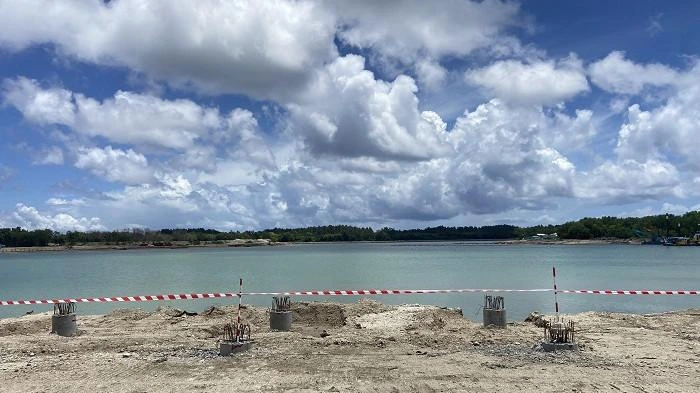
DENPASAR, DEWATA.NEWS – A special committee of the Bali Provincial Legislative Council (DPRD Bali) conducted an on-site inspection at the Kura-Kura Bali Special Economic Zone (SEZ) on Monday (February 2, 2026), following allegations of mangrove land conversion involving PT Bali Turtle Island Development (BTID).
The inspection was carried out by the DPRD’s Special Committee on the Enforcement of Regional Regulations Related to Spatial Planning, Regional Assets, and Licensing (Pansus TRAP). The visit was prompted by concerns that approximately 82.14 hectares of mangrove forest within the Ngurah Rai Grand Forest Park (Tahura Ngurah Rai) may have come under the control of BTID within the Kura-Kura Bali SEZ area.
Pansus TRAP Chair Made Supartha said the entire area currently managed by BTID was historically a mangrove habitat and designated conservation forest. He noted that even during the pre-independence era, the area had been monitored due to its protected status.
“This mangrove area was considered permanent and not to be altered because it is a protected forest. From a regulatory perspective, conservation areas must ensure the protection of mangrove habitats and ecological balance,” Supartha said.
He added that the committee would closely examine whether there were administrative flaws in the permitting documents related to any land-use changes. The committee is also seeking clarity on potential compensation mechanisms for the provincial and municipal governments if mangrove land conversion has occurred.
Pansus TRAP requested access to all relevant licensing documents held by the Forestry and Environment Agency for further review during a formal hearing. “If there is administrative malpractice, it must be accounted for,” Supartha said.
The committee also addressed reports from local residents regarding 2.19 hectares of land north of Serangan village, described as community-occupied land predating later developments. The area includes Pura Sakenan and several other temples.
In addition, discussions touched on spatial planning related to port development and proposed jetty construction. Supartha emphasized that any development must not restrict public access or community activities, particularly those of local fishermen.
“Fishing activities must not be restricted. The rights of local fishermen must be respected, and no closed or exclusive spaces should be imposed,” he said.
Responding to the allegations, BTID President Commissioner Tantowi Yahya denied claims that the company had illegally taken over 82 hectares of mangrove land. He said the term “taken over” implied unlawful action, which he rejected.
“Since the ownership of Kura-Kura Bali transferred to BTID in 1994, all processes we have undertaken have followed and complied with existing laws and regulations,” Tantowi said.
He explained that Kura-Kura Bali was officially designated as a Special Economic Zone by the central government in April 2023, following a lengthy and rigorous assessment process.
“To obtain SEZ status, an area must meet all required criteria, including administrative completeness, legal compliance, and respect for local customs,” he said.
Tantowi added that BTID became the owner of the area in 1997, while its management history dates back to the late 1980s. He said the transition process between 1989 and 1994 involved complex business considerations and social impacts.
During the DPRD forum, Tantowi welcomed feedback from lawmakers and said many of the issues raised were already addressed within the company’s internal guidelines. He stated that the input provided during the inspection would be taken into account in future planning.
The inspection forms part of ongoing legislative oversight related to spatial planning, environmental protection, and licensing compliance within Bali’s designated development zones.