
BADUNG, DEWATA.NEWS – The Bali Urban Subway project, envisioned as a long-term solution to chronic traffic congestion in key tourism areas, has yet to show visible progress more than a year after its groundbreaking ceremony.
The project officially began with a groundbreaking and traditional ngeruwak ceremony on Wednesday, 4 September 2024, at the Central Parking Area in Kuta, Badung Regency. At the time, Bali’s acting governor stated that eight Tunnel Boring Machines (TBM), each designed to drill tunnels with a diameter of 7.2 meters, were scheduled to arrive in April 2025.
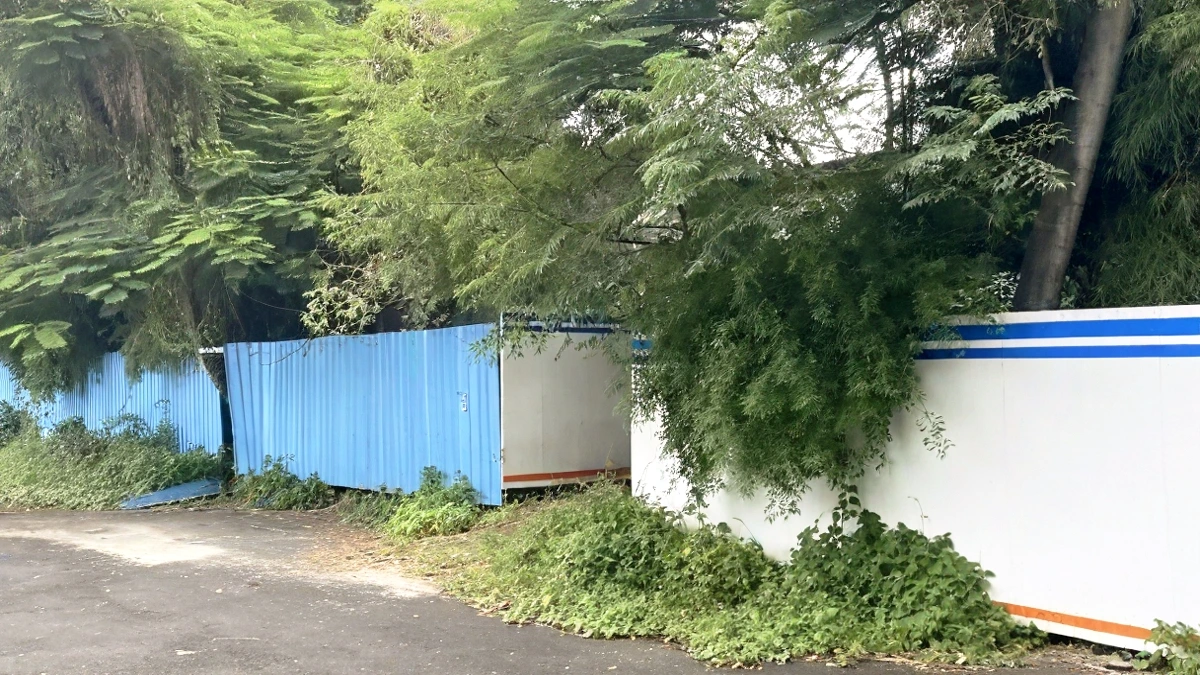
However, as of Monday (9/2/2026), the site remains undeveloped. Observations at the former groundbreaking location show an empty plot of land, fenced with yellow barriers and covered by white metal sheets bearing the name PT Sarana Bali Dwipa Jaya (SBDJ). There are no signs of construction activity, heavy machinery, or workers on site.
The lack of visible progress has raised questions about the future of the subway project, which was designed to ease congestion across the Sarbagita metropolitan area, covering Denpasar, Badung, Gianyar, and Tabanan.
Chairman of Bali Regional House of Representatives (DPRD) Commission III, Nyoman Suyasa, said the project had been planned for years but has yet to show tangible development, despite earlier indications that equipment had arrived at the site.
He explained that the Bali Urban Subway relies entirely on foreign investment and does not use regional government funds. According to Suyasa, investors from China and South Korea were previously mentioned, with the project planned in four phases. Phase one would connect the airport to Kuta, while phase two would cover Cemagi, Canggu, and Mengwi. Feasibility studies for the first two phases were reportedly completed, while studies for phases three and four were still ongoing.
“Until now, we have not received valid information on the actual progress of the subway project,” Suyasa said on Monday (9/2/2026).
He stressed that an underground rail system is urgently needed in densely populated and highly congested areas such as Kuta and Canggu. Suyasa said he plans to coordinate with relevant government agencies and the governor to seek clarity on the project’s continuation after the legislative recess.
The Head of Bali’s Transportation Agency, I Kadek Mudarta, confirmed that PT SBDJ is currently in the process of drafting a memorandum of understanding (MoU) with China North Industries Group Corporation Limited (Norinco) to conduct further planning and development studies for the railway system.
Mudarta said the agency has not yet received a formal route proposal, which is required before an official evaluation can be conducted. He also noted that there has been no recent visible progress from PT SBDJ or its partner, PT Bumi Indah Prima (BIP), adding that SBDJ is reportedly seeking new strategic partners.
“Public transportation in Bali is inevitable, given land limitations for road expansion. An underground rail system could be a necessary alternative, but the main challenge is the high cost,” Mudarta said.
Political and public policy analyst Dr. Efatha Filomeno Borromeu Duarte observed that administratively, the project has entered the construction phase, but conditions on the ground suggest otherwise.
“This shows a serious gap between policy decisions and technical implementation. The groundbreaking has taken place, but real construction has not moved significantly,” he said.
Efatha added that the decision to rely entirely on private investment carries inherent risks, particularly when the investor consortium has not demonstrated strong operational readiness. He also pointed to uncertainty caused by reported shifts in the project’s transport concept, from Light Rail Transit (LRT) to Autonomous Rail Transit (ART), even before physical construction began.
As of early 2026, no tunnel excavation has started, leaving the future of the Bali Urban Subway uncertain and reinforcing public concerns over whether the project will move beyond planning and presentation stages.