
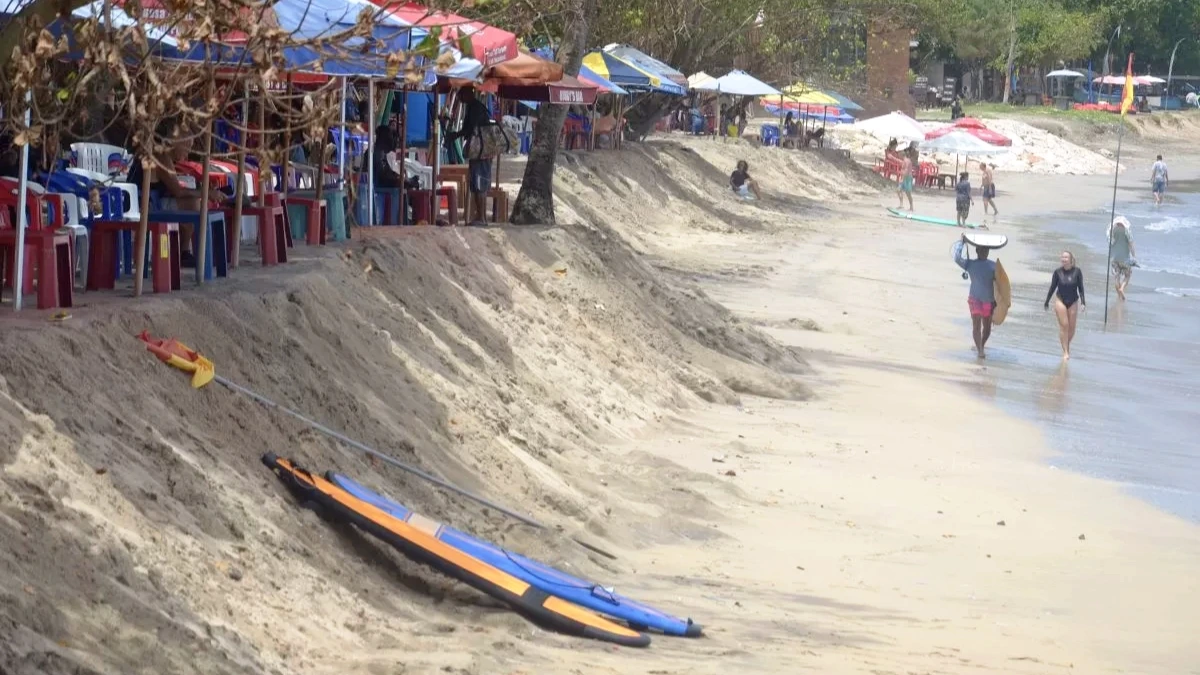
DENPASAR, DEWATA.NEWS – The Government of Japan will continue its coastal conservation project in Bali under Phase II, allocating 9.85 billion yen, equivalent to approximately IDR 1.08 trillion, with completion targeted for 2028.
The initiative aims to mitigate coastal erosion and strengthen shoreline resilience across several key tourism areas on the island.
“Japan is committed to continuing to contribute to supporting the development of Indonesia, which we cherish,” said Japanese Consul General Miyakawa Katsutoshi on Thursday (Feb 12).
Phase II of the project, running from 2021 through an estimated completion in 2028, covers multiple coastal zones. Package II includes Kuta, Legian, and Seminyak in Badung Regency. Package III spans Nusa Dua and Tanjung Benoa in Badung Regency, as well as Sanur in Denpasar City. Meanwhile, Package I extends conservation efforts to Candidasa in Karangasem Regency.
The project is implemented by the Directorate General of Water Resources under Indonesia’s Ministry of Public Works. The Phase II budget of 9.85 billion yen marks an increase from Phase I (2000–2008), which amounted to 9.5 billion yen, equivalent to around IDR 1.04 trillion at the time.
According to Miyakawa, the Bali coastal conservation program is financed through Japan’s official development assistance, aimed at reducing abrasion and revitalizing coral ecosystems.
During Phase I, conservation work in Sanur involved the placement of approximately 300,000 cubic meters of sand, along with the construction of groins and offshore breakwaters. In Nusa Dua, around 340,000 cubic meters of sand were added, accompanied by groins and headland structures.
Kuta received approximately 520,000 cubic meters of sand, offshore breakwaters, and coral transplantation efforts. Additional protective structures, including stone and coral panels, were built along the coast near Tanah Lot Temple.
Under Phase II, conservation methods will largely follow similar approaches. In Kuta–Legian–Seminyak, work includes sand replenishment and the construction of breakwaters. In Nusa Dua, Tanjung Benoa, and Sanur, sand will be sourced from the Mertasari stockpile and from areas where natural sand accumulation occurs over time.
In Candidasa, the project includes sand replenishment, repair of existing seawalls and groins, and ongoing maintenance. A groin is a structure built perpendicular to the shoreline to reduce sand movement caused by sea currents.
“Economic cooperation between Japan and Indonesia is not merely an exchange of funds or financial assistance. It is sincere collaboration to protect people’s livelihoods,” Miyakawa said during a reception marking the 66th birthday of the Emperor of Japan in Denpasar.
The continuation of the project reflects ongoing bilateral cooperation aimed at protecting Bali’s coastal areas, which are vital for local communities and the island’s tourism sector.