
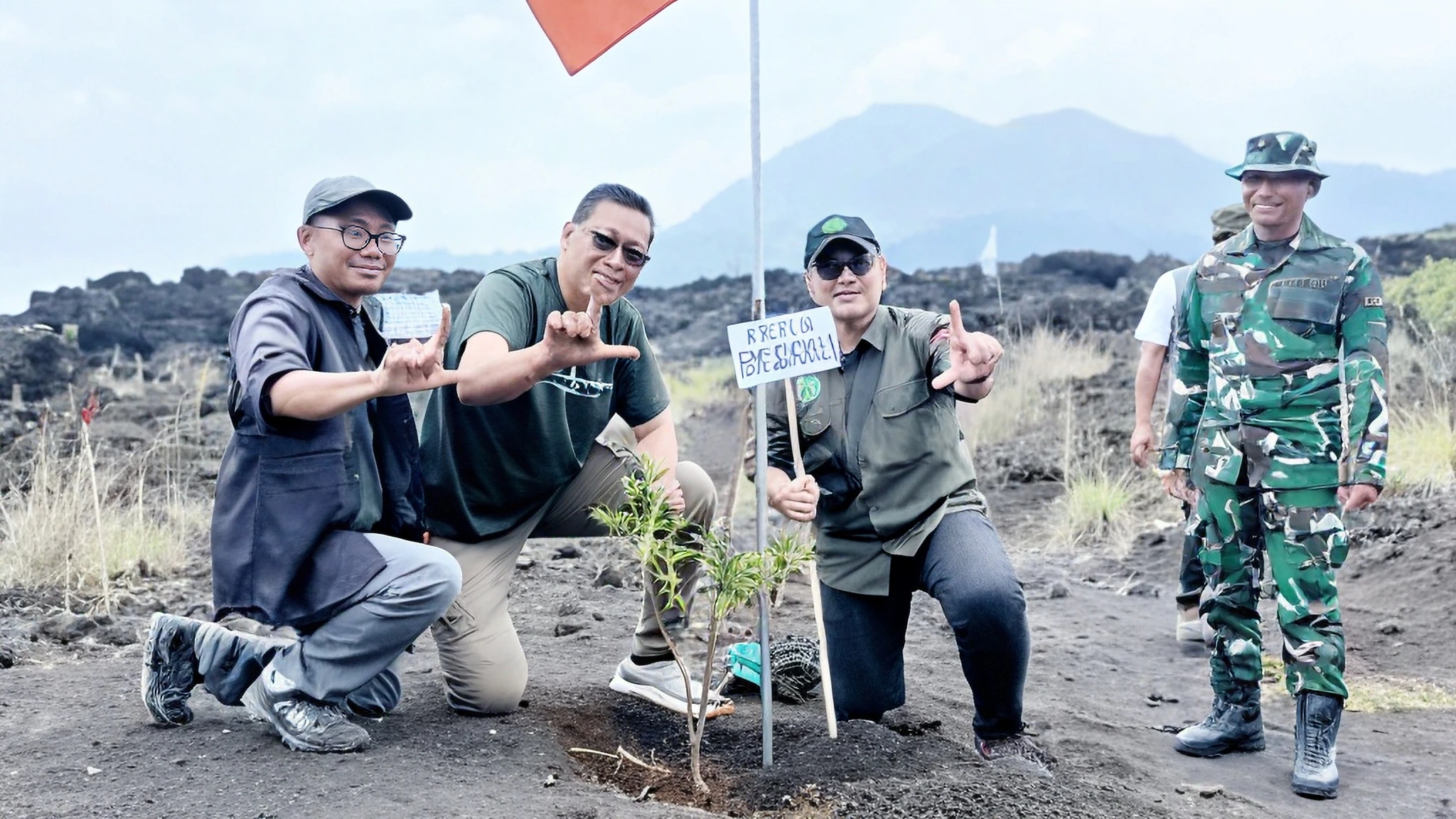
BANGLI, DEWATA.NEWS – The Bali Reforestation Festival (BRF) XVIII marked a major environmental milestone on Sunday, 14 December 2025, with the planting of 3,000 trees in Yeh Mampeh, Bukit Payang Block, within the Mount Batur Bukit Payang Nature Tourism Park (TWA) in Kintamani, Bangli Regency.
The tree-planting initiative forms part of ongoing efforts to rehabilitate upstream conservation areas that play a critical role in maintaining Bali’s environmental balance, particularly water catchment and forest ecosystems.
BRF XVIII was organized through a collaboration between Bali Natural Resources Conservation Agency (BKSDA Bali), Yayasan Bali Hijau Lestari (YBHL), and Asia Green Forest Network (AGFN) Japan.
The trees planted included ampupu, banyan (beringin), and mountain pine, selected for their strong adaptability to the volcanic terrain of Mount Batur and their importance in supporting upstream ecological stability.
Planting activities were carried out in designated rehabilitation zones within the Gunung Batur Bukit Payang conservation area.
A total of 305 participants took part in the event, representing a wide range of sectors, including environmental communities, university students, educational institutions, businesses, healthcare workers, and cross-profession volunteers.
Organizers said the broad participation reflected growing public awareness and commitment to conservation efforts in Bali.
Participating groups included Mapala Cakra Buana of Bali State Polytechnic, Faculty of Foreign Languages at Universitas Mahasaraswati, Bali Student Nature Lovers Association, RS Bhakti Rahayu, partner communities of BKSDA Bali, PMI Bangli, Orang Indonesia (OI) community, and other environmental volunteers.
Head of BKSDA Bali Ratna Hendratmoko said the success of tree-planting activities should not be measured solely by the number of trees planted, but also by their ability to inspire long-term public involvement.
“Planting trees is not just an activity. It is a lifestyle and a source of pride. True success is when it inspires the wider community and becomes a shared movement,” he said.
BKSDA Bali expressed hope that BRF XVIII would serve as a model for sustainable collaboration in managing conservation areas, particularly upstream regions with strategic environmental functions for the island.
“Conservation does not belong only to BKSDA Bali. It belongs to everyone. We ask for support from all stakeholders, and we reaffirm that BKSDA Bali remains at the forefront of conservation efforts in Bali,” Hendratmoko added.
Beyond tree planting, BRF XVIII also functioned as an educational platform and a networking forum for stakeholders involved in environmental protection. The Kintamani area, characterized by rocky and sandy soil conditions, was highlighted as a region requiring sustained attention for forest rehabilitation.
YBHL Chairman I Nyoman Gede Bayu Wiratama Suwedia said the initiative is part of a broader social movement supporting conservation in Bali.
“This activity reflects our commitment to environmental conservation. Together with volunteers, we are ready to stay actively involved in preserving Bali’s natural environment,” he said.
Adding that future reforestation efforts will expand to other conservation areas, including Buyan–Tamblingan Nature Tourism Park and additional sites with conservation potential.