
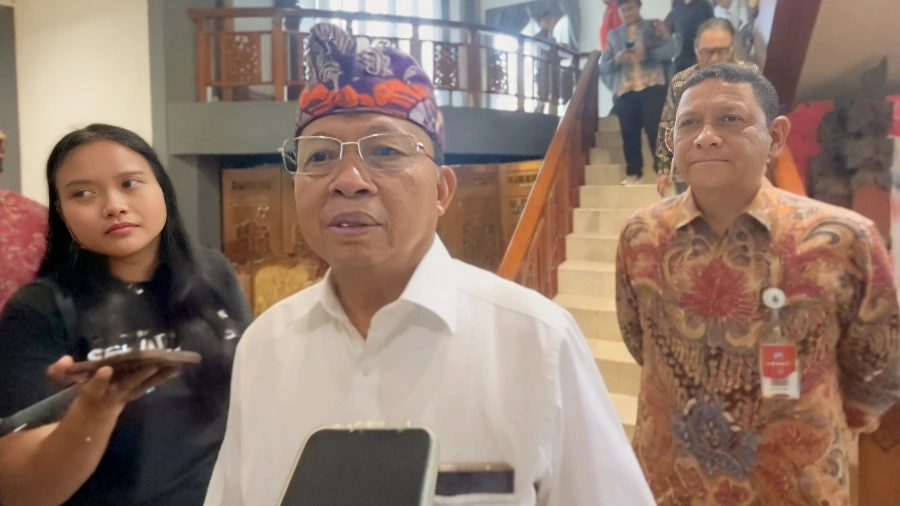
DENPASAR, DEWATA.NEWS – Bali Governor Wayan Koster said the Indonesian Attorney General’s Office has recommended strengthening the collection system for Bali’s foreign tourist levy, including possible involvement from immigration authorities to improve compliance.
The statement follows a recent request from the Attorney General’s Office for information from several Bali provincial government officials regarding the management of the IDR 150,000 foreign tourist levy charged to international visitors.
Speaking after a social conflict coordination meeting at the Wiswa Sabha Utama Building in Denpasar on Monday (March 16), Koster clarified that the officials were not questioned as part of an investigation but were asked to provide supporting data about the levy program.
“It is true they were contacted, but it was not for questioning. They only requested information and supporting data. I have received a call from the Attorney General’s Office, and they are actually helping by providing recommendations so the foreign tourist levy can be implemented more optimally,” Koster said.
According to the governor, one of the main challenges in maximizing the levy collection is the current absence of direct involvement from immigration authorities in the payment process.
Authorities are now considering integrating immigration into the system so that compliance can be improved when foreign visitors enter Indonesia through Bali.
“One of the reasons the levy has not been fully optimized is because immigration has not yet been directly involved in the collection process,” he explained.
Koster said cooperation with immigration had already been discussed but requires additional legal frameworks at the national level.
Possible regulations could include a government regulation, presidential regulation, or ministerial regulation to support the implementation of Bali Provincial Regulation No. 4 of 2023 on the Foreign Tourist Levy, which was updated in 2025.
A total of seven officials from Bali’s provincial government reportedly provided information to the Attorney General’s Office. They included representatives from the Regional Financial and Asset Management Agency (BPKAD), the provincial legal bureau, the Bali Tourism Office, the regional revenue agency, and Bali’s Public Order Agency.
Koster emphasized that there were no issues regarding the use of the collected funds, as all payments are processed digitally and transferred directly to the regional treasury through Bank Pembangunan Daerah (BPD) Bali.
“There is no corruption issue because all payments are digital, there is no cash involved. Once the payment goes through BPD Bali, it goes directly to the regional treasury,” he said.
Data from the provincial government shows that Bali recorded around 6.3 million international visitors in 2024. However, only about 2.1 million tourists, roughly 32 percent paid the levy, generating IDR 318 billion in revenue.
In 2025, international arrivals increased to approximately 7 million visitors, with the payment rate rising slightly to around 34 percent, generating IDR 369 billion in revenue.
The levy funds are allocated to programs supporting cultural preservation, environmental protection, traditional village initiatives, tourism development, infrastructure projects, and waste management.
Koster said the provincial government’s priority now is to improve the levy collection system to ensure more visitors comply with the regulation.
“The main issue is why the collection has not been optimal, and it relates to immigration. That is what we need to address by involving immigration in the process,” he said.