
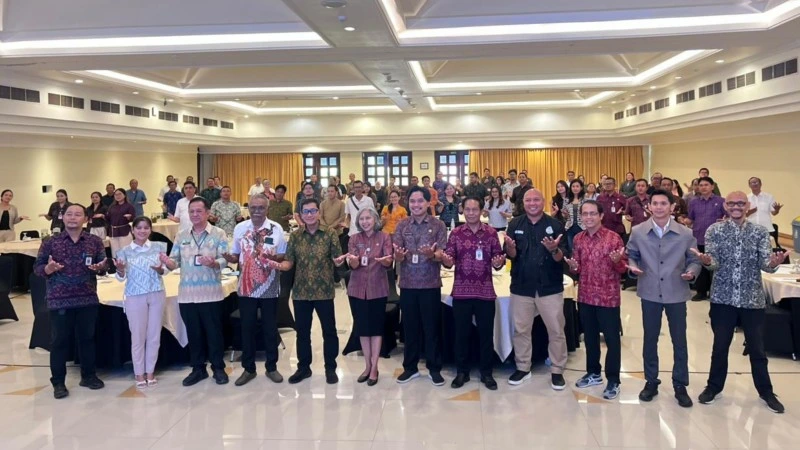
DENPASAR, DEWATA.NEWS – The Denpasar City Government is encouraging sustainable tourism practices by promoting circular economy principles through the “Gathering Destinasi 2026” forum, held on Tuesday (April 28) in Sanur.
Organized by the Denpasar Tourism Office, the event brought together stakeholders from environmental communities, tourism businesses, academia, and government institutions to discuss waste management strategies in the city’s tourism sector.
The forum, themed “Waste-to-Worth: Implementing Circular Economy in Denpasar’s Tourism,” focused on transforming waste into valuable resources while reducing environmental impact.
In a statement delivered on behalf of Denpasar Mayor I Gusti Ngurah Jaya Negara, Regional Secretary I Gusti Ngurah Eddy Mulya highlighted the growing importance of sustainable tourism in Denpasar as both an urban center and an international travel destination.
“Waste management, particularly from the tourism sector, must be handled in an integrated way. It affects not only the environment but also the destination’s image and visitor comfort,” the statement said.
Officials noted that increasing tourism activity has contributed to rising waste volumes, making coordinated efforts across sectors essential.
Environmental community representative AA Ngurah Srijaya Widiada emphasized the importance of consistent small actions, encouraging stakeholders to adopt zero-waste practices starting with waste separation at the source.
“Small actions can create a big impact if applied consistently,” he said.
Meanwhile, Waterbom Bali shared its environmental management practices as a tourism operator. The facility applies sustainability principles based on water, waste, and energy management.
According to the presentation, the park generates an average of 1,197 kilograms of waste per day, equivalent to around 0.3 kilograms per visitor—lower than the national average of 0.7 kilograms. Approximately 330 tons of organic waste are processed annually through internal composting, reducing emissions by an estimated 17 tons of CO2 equivalent.
Academic and entrepreneur I Komang T. Ananda D. Priantara introduced the potential of blockchain technology in waste management systems, highlighting its ability to improve transparency, traceability, and incentive-based participation.
A representative from Denpasar’s Environmental Agency (DLHK), Kadek Mahendra, stressed that waste management remains a key issue in sustainable urban development.
“Successful waste management depends on collaboration between government, communities, and businesses,” he said.
Through this forum, Denpasar aims to shift the perception of waste from a burden into an economic resource, supporting the development of a more sustainable and higher-quality tourism sector.