
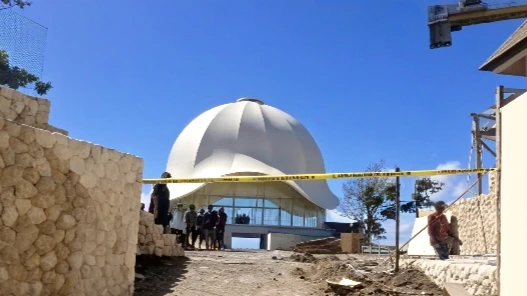
BADUNG, DEWATA.NEWS – Bali lawmakers have raised concerns over the continued construction of the O’laya wedding chapel project above Suluban Beach in Pecatu after the site was previously sealed by Badung authorities over permit issues.
Members of the Bali Regional House of Representatives’ Special Committee on Spatial Planning, Regional Assets, and Licensing (Pansus TRAP) conducted an inspection at the project site on Friday (May 8, 2026).
During the visit, council members questioned possible violations of spatial planning regulations, citing the project’s location near a cliff edge and ravine in the Uluwatu area.
“This is clearly unacceptable because the building is directly beside the cliff,” said Pansus TRAP Secretary Dewa Nyoman Rai.
The project had earlier been sealed by Civil Service Investigators (PPNS) from the Badung Regency Government in early February due to incomplete permits. However, lawmakers found that the official sealing line had disappeared and construction activities were continuing during the inspection.
Rai questioned who had removed the seal from the project area, noting that project representatives were not present during the site visit.
“I do not believe Badung Satpol PP officers removed the seal. In my opinion, it may have been done by the company itself,” he said.
In addition to the O’laya project, lawmakers also highlighted several restaurants and cafés built near cliff areas in southern Bali, including Delpi Beach, Single Fin, and The Edge.
The committee questioned the validity and issuance process of Building Approval Permits (PBG) associated with properties located near ravines and cliffside zones.
“These buildings are all located near ravines, similar to what happened in Bingin. The situation is very concerning,” Rai stated.
He emphasized that development within protected cliff border zones should not be tolerated because it could create a wider precedent for similar construction elsewhere in Bali.
According to lawmakers, spatial planning restrictions related to cliffside and protected zones are regulated under Indonesia’s Spatial Planning Law No. 26 of 2007, as well as Bali Provincial Regulation No. 2 of 2023 concerning the province’s spatial planning framework for 2023–2043.
“If this is tolerated, it will spread and other regions will follow,” Rai added.
The case is a continuation of earlier controversy surrounding the O’laya chapel development, which previously drew public attention due to its location above the Suluban coastal cliff area, one of Bali’s internationally known tourism destinations.