
DENPASAR, DEWATA.NEWS – Bali Governor Wayan Koster has intensified preparations for the development of a waste-to-energy (WtE) facility that is expected to become a long-term solution for the island’s growing waste management challenges.
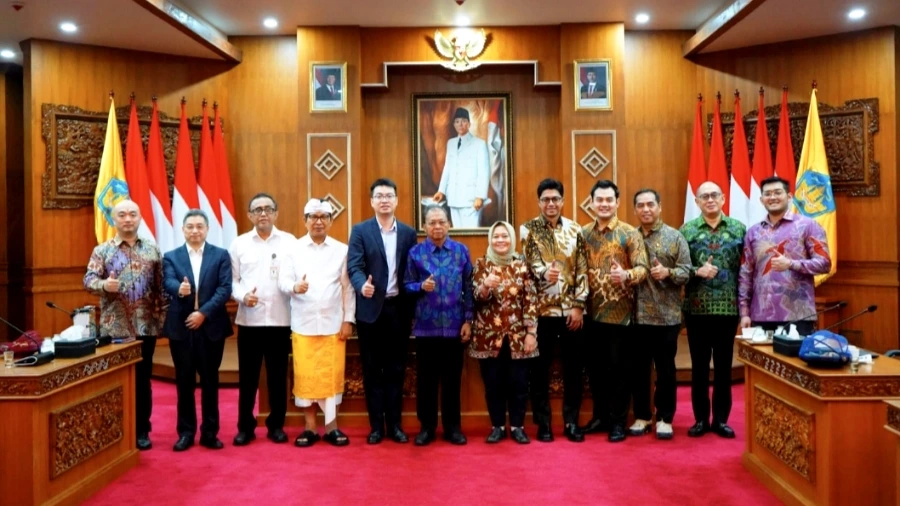
The plan was discussed during a meeting with representatives from the central government, Indonesia’s investment agency Danantara, and Chinese investor Zhejiang Weiming Environment Protection Co., Ltd., which has been appointed to develop the waste-to-energy project in Greater Denpasar and Bekasi.
The meeting on Wednesday (March 11) was also attended by Badung Regent I Wayan Adi Arnawa and Denpasar Mayor IGN Jaya Negara.
Governor Koster emphasized that Bali is ready to become a priority region for the development of waste-to-energy technology, noting that the project has been widely anticipated by residents as the island continues to face rising waste volumes linked to tourism growth.
“In Bali we are already working as one team, the governor, mayors, and regents. The land has been prepared, access roads are available, and public outreach has been conducted. In principle, the community supports the project, so now it just needs to move forward,” Koster said.
He added that the Bali Provincial Government will provide full support to accelerate the project and has requested clear timelines and construction progress updates to ensure efficient implementation.
“We are ready to support whatever is needed so this project can run smoothly. Waste management is an issue that the people of Bali have been waiting to see resolved,” he said.
From the central government, Deputy for Food Security and Affordability at the Coordinating Ministry for Food Affairs, Nani Hendiarti, reaffirmed the government’s commitment to overseeing the acceleration of the project, including coordination with Danantara as the project developer and manager.
According to her, Bali is included in the first batch of waste-to-energy projects that will soon be discussed in a limited coordination meeting at the national level.
The government plans to formally launch the program in four locations on April 6 through the signing of cooperation agreements.
“We ask for the support of local governments to finalize the cooperation agreement between regional administrations and Danantara, including commitments regarding the daily volume of waste to be processed,” Nani said.
Authorities are targeting the groundbreaking ceremony for the Bali waste-to-energy facility by the end of June 2026.
During the transition period before the facility becomes operational, the central government will also oversee policies related to landfill closures while ensuring that waste management services continue to operate.
Representatives from Zhejiang Weiming confirmed that the technology planned for the Bali facility will meet European emission standards to ensure air quality protection.
The plant is also designed with a zero-leachate system, meaning wastewater generated during the waste treatment process will be fully managed to prevent environmental contamination.
Residue from the processing system will be minimized, and some materials can be reused for construction purposes such as concrete blocks and paving materials.
Additional support is also being prepared to strengthen the modern waste management system, including the use of electric garbage trucks for waste transportation.
With the acceleration of the project, Bali is expected to become one of the first regions in Indonesia to operate a large-scale waste-to-energy facility, potentially serving as a model for integrated waste management in other parts of the country.