
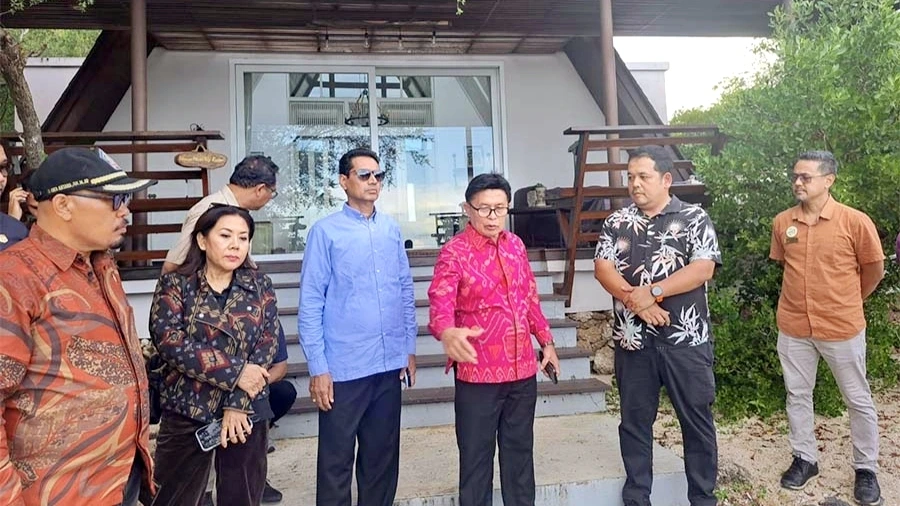
BULELENG, DEWATA.NEWS – A special committee of the Bali Provincial Parliament (DPRD Bali) has launched an on-site inspection into alleged spatial planning and environmental violations at a luxury resort in Buleleng, located within the West Bali National Park area.
The inspection was carried out on Tuesday (April 28) by the Special Committee on Spatial Planning, Assets, and Licensing (Pansus TRAP), led by its chairman I Made Supartha. The team identified suspected irregularities involving several villas believed to be built in protected mangrove zones.
Out of approximately 18 villas spread across an estimated 382 hectares, at least five units were found to be potentially located within conserved mangrove areas. The committee also noted indications of mangrove clearing, land compaction, and possible violations of coastal setback regulations, which require a minimum distance of 100 meters from the highest tide line.
Supartha raised concerns over the environmental impact in contrast to the resort’s high-end positioning, with some villas reportedly priced at up to IDR 13.5 million per night.
“There should be no compromise when it comes to damage in protected areas,” he said.
Based on these findings, the committee recommended a temporary suspension of operations for several villas pending a full investigation.
“We recommend a temporary closure of certain units until the investigation is completed,” Supartha added.
The committee emphasized that large-scale land use, particularly in ecologically sensitive areas, carries significant responsibility and must comply with regional regulations designed to maintain Bali’s environmental balance.
According to the committee, the alleged violations may intersect with multiple national and regional laws, including regulations on biodiversity conservation, forestry, environmental protection, spatial planning, and coastal management.
If violations are confirmed, potential penalties could include up to 10 years in prison, fines of up to IDR 10 billion, as well as administrative sanctions such as license revocation, suspension of operations, and mandatory environmental restoration, including mangrove rehabilitation.
The case adds to ongoing concerns about mangrove degradation in Bali, which plays a critical role in preventing coastal erosion and maintaining natural habitats.
The committee has urged relevant authorities, including forestry officials overseeing the West Bali National Park, to take firm, transparent, and measured action.
“Protecting Bali’s natural environment is non-negotiable. No investment should come at the expense of environmental sustainability,” Supartha said.
The inspection was attended by several members of the Pansus TRAP committee, along with representatives from the West Bali forestry authority and related government agencies.