
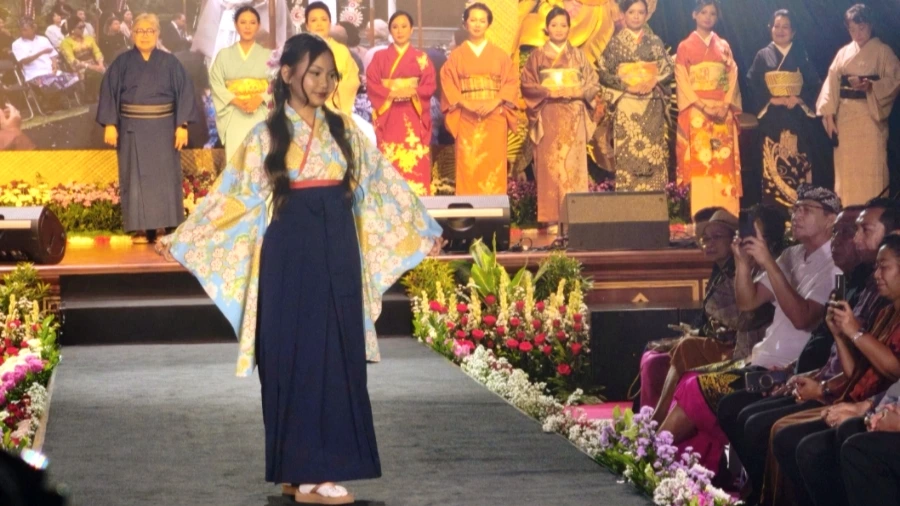
DENPASAR, DEWATA.NEWS – Japanese kimono traditions and Indonesia’s rich textile heritage came together in a cultural fashion showcase during the Bali World Culture Celebration (BWCC) 2026, part of the 48th Bali Arts Festival (PKB), held at Kerta Sabha Hall, Jayasabha, Denpasar, on Saturday evening (June 20).
Presented by Tokyo-based Kimono Gallery Yawara, the event highlighted the cultural values, philosophy, and craftsmanship behind traditional Japanese kimono while exploring creative collaborations with Indonesian textiles, including Bali’s iconic endek fabric.
More than a fashion show, the performance served as a cultural exchange platform, bringing together two textile traditions that both carry deep symbolic meanings through their patterns and designs.
Before the showcase began, Bali Governor Wayan Koster welcomed guests and expressed appreciation to former Indonesian Ambassador to Japan Heri Akhmadi and the Japanese delegation for participating in this year’s Bali Arts Festival through BWCC 2026.
“This is the first time. Thank you to Mr. Heri and the team for joining this event and contributing to the Bali Arts Festival, which is also hosting the Bali World Culture Celebration,”Koster said.
He described Japan’s participation as a new cultural experience and an example of cultural diplomacy that helps strengthen ties between Bali and Japan.
According to Koster, BWCC reflects the Bali Provincial Government’s commitment to preserving and advancing culture by creating opportunities for artists and cultural communities from different regions and countries to connect and learn from one another.
The governor also noted that the Bali Arts Festival, first held on June 20, 1979, has continued to grow over the past 48 years by expanding artistic participation and improving the quality of its programs.
Koster added that relations between Bali and Japan have developed positively in areas such as education and employment, with many young Balinese joining internship and work programs in Japan.
“Balinese people speak little and work hard with dedication. That work ethic is also very similar to Japanese society,” he said.
The evening opened with a traditional Taiko drum performance, introducing audiences to Japanese culture before a presentation of various kimono styles and the stories behind them.
Japanese Consul General in Denpasar Miyakawa Katsutoshi said kimono represents far more than traditional clothing and remains an important part of Japanese cultural identity.
“Tonight’s main star is certainly one of Japan’s most iconic cultural symbols, the kimono. For Japanese people, a kimono is more than just traditional clothing,” he said.
Miyakawa explained that many kimono motifs carry symbolic meanings. Cherry blossoms represent the beauty of life, bamboo symbolizes hope and longevity, while wave patterns reflect resilience and harmony between people and nature.
He noted similarities between these philosophies and Bali’s endek textiles, which also incorporate natural elements and symbolic meanings into their designs.
“This combination is not only a fashion collaboration but also a cultural dialogue that shows traditions can meet, inspire one another, and create new forms of creativity without losing their identities,” Miyakawa said.
The showcase introduced 11 different types of kimono, including Kurotomesode, Japan’s highest-ranking formal black kimono traditionally worn by close family members at weddings.
Other styles included the long-sleeved Furisode, commonly associated with young women, Homongi for formal occasions, and the more understated yet elegant Tsukesage.
Visitors were also introduced to Komon and Edo Komon, kimono styles commonly worn in daily life that feature intricate craftsmanship despite their simple appearance.
The presentation included men’s cotton kimono paired with Hakata obi belts, Hakama garments typically worn during graduation ceremonies, and children’s kimono used in the traditional Shichi-Go-San celebration.
The event later featured collaborative designs created by Kimono Gallery Yawara, blending Japanese fabrics with Indonesian textiles such as Balinese endek, Javanese batik, and woven fabrics from across the archipelago.
Kimono Gallery Yawara Director Tomi Nakamura said the collection was developed over a three-year period to create a meeting point between Japanese and Indonesian traditions.
“We hope this collaboration will create new harmony, new inspiration, and strengthen friendship between our two countries,” Nakamura said.
The collection combined traditional Japanese fabrics including Jujigasuri, Edo Komon, Roketsuzome, Oshima Tsumugi, and Akashi Chijimi with Balinese endek. Several designs also paired Japanese silk with Javanese batik and other Indonesian woven textiles.
One of the collection’s distinctive features was the use of reversible kimono designs, allowing wearers to display different looks within a single garment. Japanese and Balinese obi belts were also combined to highlight elements from both cultures.
While preserving the traditional kimono silhouette, Nakamura said the designs were adapted to be more practical and accessible for younger generations.
The event was attended by Bali Dekranasda Chair Ni Luh Putri Suastini Koster, former Ambassador Heri Akhmadi, members of the Japanese community in Bali, designers, and cultural practitioners, concluding in a warm atmosphere that celebrated friendship and cultural exchange between Indonesia and Japan.