
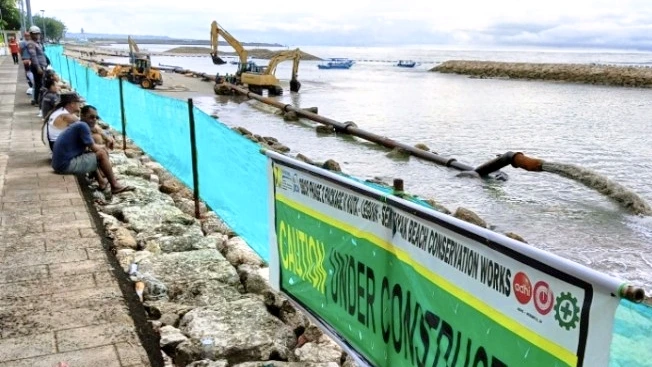
BADUNG, DEWATA.NEWS – Efforts to restore the eroded coastline of Kuta Beach have entered a key construction phase, with sand replenishment now underway as part of the Bali Beach Conservation Project (BBCP) Phase II.
The initial work is focused on Zone II, covering the stretch from the area near Anvaya Hotel to Pullman, where coastal erosion has been identified as most severe.
Officials from the Bali-Penida River Basin Agency confirmed that sand filling began this week, with operations adjusted to tidal conditions.
“Sand placement has started and is being carried out in line with tidal cycles, beginning from Zone II near the Anvaya area,” said Bambang Kardono, Project Commitment Officer, on Tuesday (April 21).
Trial operations had already been conducted since Sunday (April 19), with active sand placement extending along sections toward Alam Kulkul.
Authorities said prior to full-scale work, outreach was conducted with tourism businesses and local stakeholders along the beach to ensure coordination and minimize disruption.
“We have informed tourism operators about the work zones and equipment used, so beach activities can adjust accordingly,” said I Gede Lanang Sunu Perbawa, Head of Water Resources Implementation at the agency.
The project uses a specialized vessel known as a trailing suction hopper dredger (TSHD), which collects sand from offshore waters before transporting and pumping it onto the beach through pipelines.
The sand is distributed in stages along the coastline, moving from south to north.
For Zone II, the project targets approximately 319,000 cubic meters of sand, with the aim of increasing the beach’s flat width by around 15 meters. The sloped section is designed to extend between 25 to 35 meters with a gradient ratio of 1:8.
Authorities noted that erosion in this zone is particularly severe, especially between the tsunami shelter area and the Beachwalk Mall stretch, making it a priority for early intervention.
The sand filling in Zone II is scheduled for completion by June 2026, depending on weather conditions and operational factors. The project will then continue to Zone I near the airport runway, followed by Zone III.
To ensure safety during construction, work areas will be restricted with designated barriers to prevent public access.
“We will secure the work zones to ensure public safety, as this is a high-activity tourism area,” Lanang said.
In addition to sand replenishment, the installation of offshore breakwaters is nearing completion. Four out of five planned units have been completed, with the final structure currently reaching around 90 percent progress.
The project is part of a broader effort to protect Bali’s coastline while maintaining the functionality and appeal of one of its most visited beaches.