
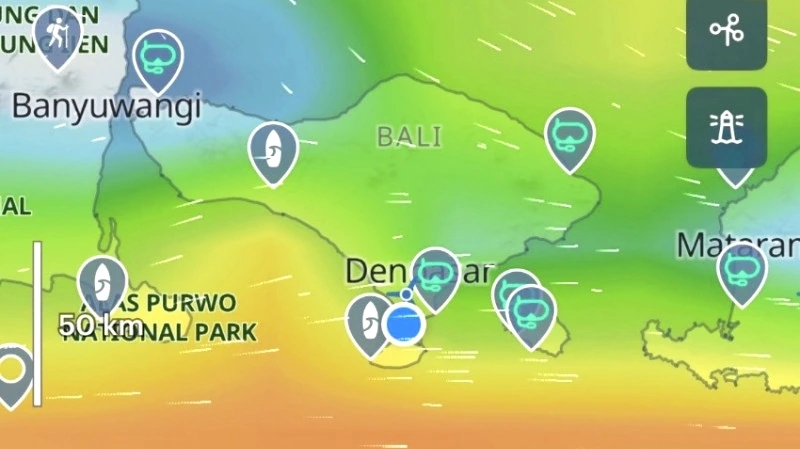
DENPASAR, DEWATA.NEWS – Strong winds that have affected several parts of Bali in recent days are being driven by a combination of regional and global atmospheric conditions, according to the Meteorology, Climatology, and Geophysics Agency (BMKG).
The Meteorology Station at I Gusti Ngurah Rai recorded maximum wind speeds reaching 37 knots, or around 68 kilometers per hour, during the recent weather disturbances.
Ariantika, a forecaster from BMKG Region III Denpasar, explained that the strong winds are caused by a convergence pattern, where different air masses meet around Bali. The situation is also influenced by the active Madden-Julian Oscillation (MJO) Phase 4, which typically increases the formation of rain clouds over the Maritime Continent region.
In addition, a developing tropical cyclone system identified as Seed 90S in the southern waters of the Indian Ocean southwest of Banten has been moving eastward toward the waters south of Bali.
“This condition is also supported by equatorial Rossby and Kelvin waves that are predicted to pass over the Bali region in the coming days,” Ariantika said on Thursday (March 5).
She noted that strong winds recorded at the Ngurah Rai Meteorological Station reached a maximum of 37 knots, or about 68 km/h. The stronger winds that often occur at night may also be triggered by a downburst phenomenon from Cumulonimbus (Cb) clouds.
Such conditions are commonly observed during the development of tropical cyclone systems, particularly when surface heating earlier in the day increases evaporation and the growth of convective clouds.
“Currently, tropical cyclone seed 90S is located in waters south of Java and moving eastward toward waters south of Bali, so the potential for stronger winds is expected to continue at least until March 7, with fluctuating intensity,” she explained.
Several areas in Bali are advised to increase vigilance, including Badung Regency, Denpasar City, Jembrana, Tabanan, and Klungkung, especially the island of Nusa Penida.
Apart from strong winds and heavy rain, the developing cyclone system has also affected sea conditions. BMKG reported wave heights in southern Bali waters reaching between 1 and 5 meters, while northern Bali waters recorded waves between 0.5 and 2 meters.
These conditions pose potential risks to shipping activities, fishermen, and people working at sea.
Residents are advised to remain alert for hydrometeorological hazards such as flooding, water pooling, and fallen trees during the period of extreme weather. Fishermen and marine tourism operators are also urged to monitor sea conditions, as waves could exceed 2 meters in the coming days.
“We also encourage residents to keep emergency contact numbers ready to report disaster incidents as part of mitigation efforts. Weather updates should only be followed through official BMKG platforms,” Ariantika added.