
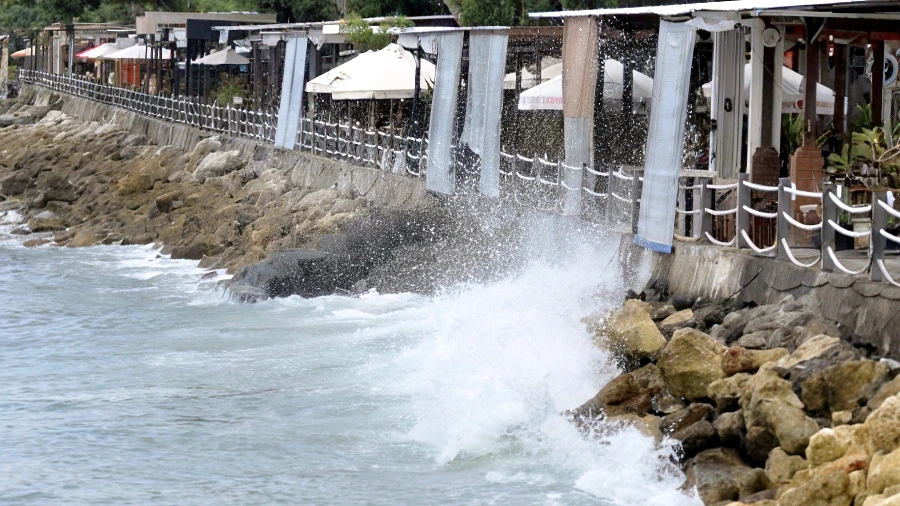
DENPASAR, DEWATA.NEWS – Authorities are urging residents and coastal communities in Bali to remain alert following an early warning of potential peak sea tides between March 23 and 25, 2026.
The warning follows a perigee phase that occurred on March 22, when the Moon is at its closest point to Earth. This condition can amplify gravitational forces and lead to higher-than-normal sea levels along several coastal areas.
According to the Meteorology, Climatology, and Geophysics Agency (BMKG) Region III, areas potentially affected include the southern coasts of Jembrana, Tabanan, Badung, Denpasar, Gianyar, and Klungkung. The increase in sea level may trigger tidal flooding, with timing varying across locations.
The situation could disrupt a range of coastal activities, including port operations, residential areas near shorelines, as well as salt farming and inland fisheries.
Head of Bali’s Regional Disaster Management Agency (BPBD), Gede Teja, explained that tidal fluctuations are a natural phenomenon influenced by the gravitational pull of the Moon and the Sun, combined with Earth’s rotation. When the Moon and Sun are aligned, the combined gravitational force intensifies, leading to peak tidal conditions.
“This has the potential to cause tidal flooding in several coastal areas of Bali, especially in low-lying regions close to the shoreline,” he said on Tuesday (March 24).
He emphasized that such events are not new for coastal communities, noting that local governments have implemented mitigation measures, including the construction of seawalls and breakwaters in vulnerable areas, along with routine dissemination of early warning information.
“If emergency conditions occur, preparedness measures will be activated, including evacuation and the provision of basic needs for affected communities,” he added.
BPBD Bali also advised the public to monitor official updates from BMKG and rely on verified information to avoid misinformation. Residents living in coastal areas are encouraged to stay vigilant and anticipate possible impacts during the peak tide period.