
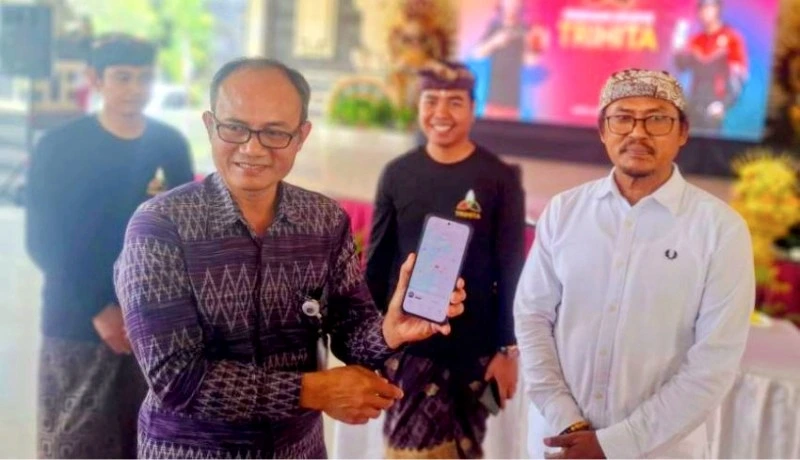
TABANAN, DEWATA.NEWS – Bali has officially launched a new locally based transportation platform called TRIHITA, a green transport initiative designed to involve traditional villages in the island’s growing digital and tourism economy.
The application, officially named Transportasi Hijau Terintegrasi Berbasis Desa Adat (Integrated Green Transportation Based on Traditional Villages), was launched at Wantilan Desa Adat Beraban in Tabanan on Saturday, May 16, 2026.
The initiative follows a meeting held earlier this year between Bali Governor Wayan Koster and representatives of traditional villages at Jayasabha, where officials discussed the development of community-based modern transportation systems in Bali.
The launch event was attended by transportation and traditional community officials from Bali Province, Denpasar City, and Badung Regency, alongside dozens of traditional village leaders from major tourism areas including Canggu, Seminyak, Legian, Kuta, Sanur, and Ubud.
These areas are among Bali’s busiest tourism zones and have experienced increasing traffic congestion alongside rapid tourism growth.
CEO and Founder of TRIHITA, I Made Sudiana, said the platform was created in response to concerns that local communities have not fully benefited from Bali’s expanding tourism and digital economy sectors.
According to Sudiana, many economic opportunities linked to tourism and technology have been dominated by outside parties while traditional villages and local residents remain underrepresented.
“If we look at the real conditions in tourism-affected traditional villages, the role of local communities is still very limited. Many economic opportunities are controlled by outsiders. That is our concern,” Sudiana said.
The former Badung vice regent explained that TRIHITA is intended not only as an online transportation application but also as a broader digital economic platform based on traditional village participation.
The system is expected to create wider market access for local businesses and small enterprises across Bali.
Implementation will initially begin through seven traditional villages serving as pilot projects before expanding into other regions.
Head of Bali Provincial Transportation Agency I Made Mudarta described the initiative as a positive step because it combines local economic empowerment with modern transportation systems.
However, he emphasized that future development must still comply with transportation and digital information regulations.
“This is a community initiative with the spirit of involving traditional villages and empowering local communities. Of course, this is something worthy of appreciation,” Mudarta said.
Denpasar Transportation Agency Head I Ketut Sriawan said applications such as TRIHITA could help address Bali’s ongoing transportation challenges while also improving income opportunities for local drivers.
He added that increased village revenue generated through the platform could support traditional ceremonies and cultural preservation activities.
“If traditional villages have income, it can support ceremonies and cultural activities to maintain harmony between nature and Balinese culture,” he said.
Badung Transportation Agency Head AA Gde Rahmadi also expressed support for the concept, saying transportation systems based on traditional villages align with Bali’s broader vision for quality tourism development.
The launch of TRIHITA comes amid growing public attention over traffic congestion across South Bali tourism areas. The platform is being promoted as an alternative model combining digital technology, local economic participation, and Bali’s traditional social structure within one integrated ecosystem.