
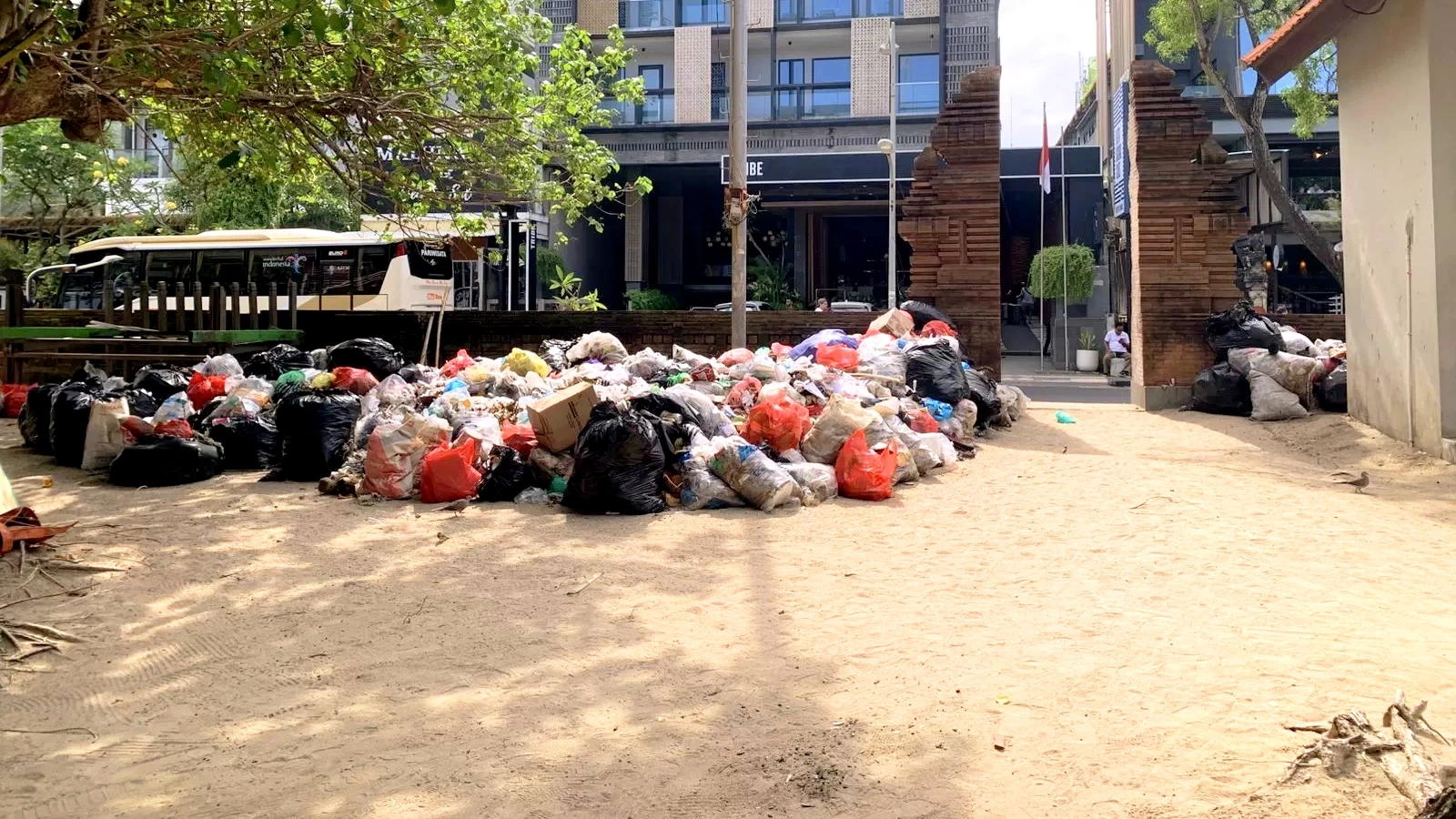
BADUNG, DEWATA.NEWS – Waste accumulation has resurfaced at Kuta Beach, raising concerns over environmental management in one of Bali’s busiest tourism areas, just days after previous cleanup efforts were completed.
Local authorities began removing the newly discovered piles on Monday (April 20, 2026), following reports of plastic-wrapped waste appearing at multiple points along the beach.
Manager of the Kuta Beach tourism area, I Nyoman Arya Arimbawa, said initial cleanup has covered several locations, including areas near a coffee shop and the skatepark parking gate. However, waste remains in sections closer to the Legian border.
He noted that the cleanup process has been constrained by limited resources.
“We are still waiting for additional trucks and coordinating with the Environmental Agency to accelerate waste removal,” he said.
Currently, the operation relies on seven rented trucks, which are not sufficient to handle the full volume of waste within a short timeframe.
Authorities suspect that the waste may not originate from activities within the Kuta Beach area. Most of the material consists of mixed and residual waste, while organic waste is regularly collected on a daily basis.
“There are indications that the waste comes from outside the area. We are coordinating with local traditional leaders and village authorities to trace its source,” Arimbawa added.
Kuta traditional village leader I Komang Alit Ardana confirmed that cleanup efforts are ongoing, with additional resources being sought to speed up the process.
He also pointed to irresponsible dumping practices as a contributing factor.
“There are parties who irresponsibly dispose of waste in this area,” he said.
Meanwhile, Chairman of Commission IV of the Badung Regional House of Representatives, I Nyoman Graha Wicaksana, emphasized the need for a stronger, area-based waste management system.
“This issue cannot be handled solely through technical measures. Public awareness and behavior change are equally important,” he said.
He urged tourism managers to take a leading role in educating stakeholders and called for clearer identification of waste sources. He also recommended expanding community-based waste management programs (TPS3R) in densely populated areas such as Kuta, South Kuta, and North Kuta.
In addition, he highlighted the importance of implementing reward and penalty systems to encourage responsible waste disposal, while warning against illegal waste burning that could affect air quality.
Authorities stress that addressing waste issues at Kuta Beach requires a comprehensive approach, combining operational improvements, cross-sector coordination, and increased public awareness to maintain the area’s cleanliness and appeal for visitors.