
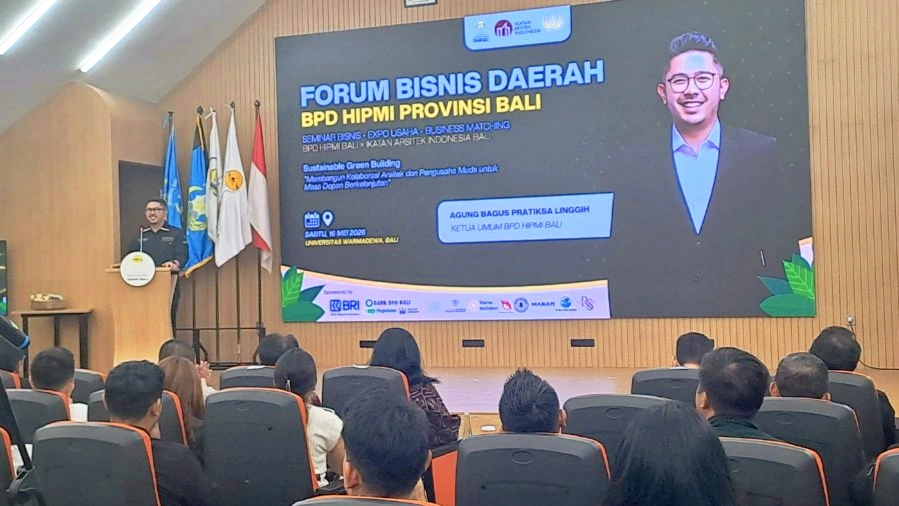
DENPASAR, DEWATA.NEWS – Sustainable green building has emerged as a key focus in Bali’s future economic development strategy as the island faces rapid growth in property investment and tourism infrastructure.
The issue was highlighted during the Regional Business Forum (Forbisda) titled “Sustainable Green Building: Building Collaboration Between Architects and Young Entrepreneurs for a Sustainable Future” held at Warmadewa University on Saturday, May 16, 2026.
The event brought together business leaders, architects, academics, and government representatives to discuss environmentally sustainable development models for Bali amid increasing construction activity across the island.
Chairman of the Indonesian Young Entrepreneurs Association (HIPMI) Bali, Agung Bagus Pratiksa Linggih, said Bali needs a more balanced development approach to ensure economic growth does not come at the expense of the environment or local cultural identity.
According to him, the green building concept is becoming increasingly important as residential and tourism accommodation projects continue expanding while Bali’s land area remains limited.
“Bali must begin implementing sustainable green building so development does not damage environmental and cultural balance,” he said.
The forum was organized in collaboration with the Indonesian Institute of Architects (IAI) Bali Province and included business and architecture seminars, business matching sessions, networking events, exhibitions, and awards for business plan and architectural design competitions.
Linggih, widely known as Ajus, said Bali’s architectural sector holds strong potential to create new businesses while also strengthening the island’s cultural identity.
He expressed hope that Balinese architectural styles could gain broader recognition beyond Bali and become more widely known nationally and internationally.
“With the emergence of new entrepreneurs in architecture, Balinese architecture can expand beyond Bali and become more widely recognized,” he said.
During the event, HIPMI Bali and Warmadewa University also signed a memorandum of understanding aimed at strengthening cooperation between entrepreneurs, academic institutions, and government stakeholders in supporting green building-based economic development.
Ajus emphasized that collaboration between businesses, universities, and government institutions is essential to creating more young entrepreneurs in Bali.
He also stressed the importance of ensuring local business participation amid growing foreign investment and global economic uncertainty.
“Local communities should not become mere spectators. Balinese entrepreneurs must grow together with incoming investment,” he said.
According to HIPMI Bali, the organization currently has nearly 700 members, most of whom operate in construction, tourism, travel services, and other industries supporting Bali’s tourism-driven economy.