
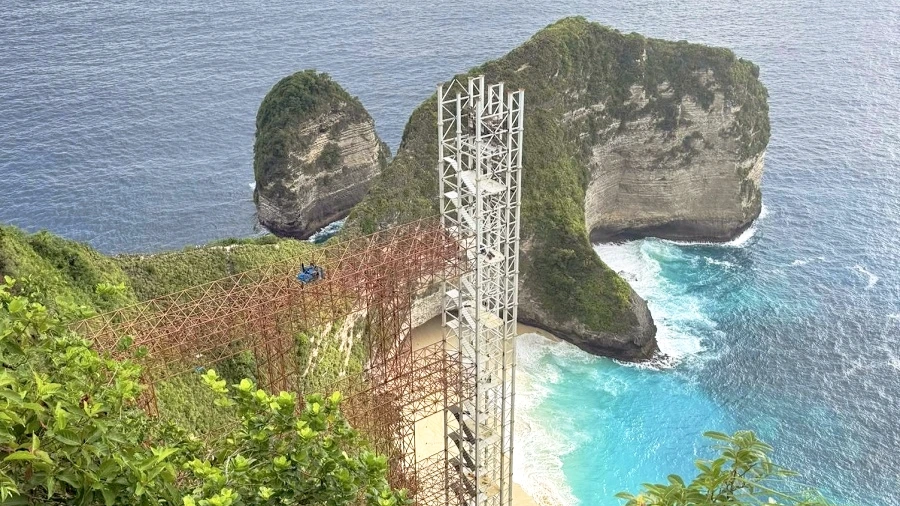
KLUNGKUNG, DEWATA.NEWS – A legal dispute over the controversial glass elevator project at Kelingking Beach, Nusa Penida, has officially entered court proceedings, with authorities confirming the case is still in its preliminary stage at the Denpasar Administrative Court (PTUN).
The Bali Provincial Government stated that the current process remains at the dismissal stage, where the court reviews the administrative completeness of the lawsuit before proceeding to the main case.
Head of the Bali Provincial Legal Bureau, Ngurah Satria Wardana, explained that the lawsuit filed by the project’s investor focuses on administrative decisions rather than investment value.
“What is being tested in the administrative court is the decision of a state administrative official. The object of the dispute is the official decree, not the investment itself,” he said on Wednesday (April 1, 2026).
The investor, PT Indonesia Kaishi Tourism Property Investment Development Group, filed the lawsuit after authorities halted the glass elevator project. While the initial claim targeted the Bali Governor, it has since been revised to focus on the Public Order Agency (Satpol PP), which issued the orders to stop, close, and dismantle the project.
According to Satria, under administrative law, only decisions that are concrete, individual, and final meaning they have legal consequences, can be challenged in court. In this case, the enforcement letter issued by Satpol PP is the primary subject under review.
“This is still in the claim revision stage within the dismissal process, so it has not yet entered the core case,” he emphasized.
He added that prior to filing the lawsuit, the investor had pursued administrative remedies, including formal objections and an appeal to the Bali Governor. After those efforts were rejected, the case proceeded to court.
The provincial government also highlighted concerns over licensing compliance as the root of the dispute. Officials stated that while the investor held permits for certain surface-level structures, such as ticketing facilities, the broader construction extending to cliffside and coastal areas, requires more complex approvals, including from central government authorities.
“The permit only covers structures on land. Construction on cliffs and marine areas requires additional studies and permits, including from the central government,” Satria explained.
Authorities stressed that enforcement actions were taken as part of legal compliance, not as a barrier to investment.
“This should not be framed incorrectly. If all permits were complete from the beginning, there would be no issue,” he said.
Safety concerns were also raised, particularly regarding construction on steep cliff areas, which are considered high-risk without proper technical assessment.
The case remains in its early stage, with further proceedings dependent on the outcome of the administrative review during the dismissal process.