
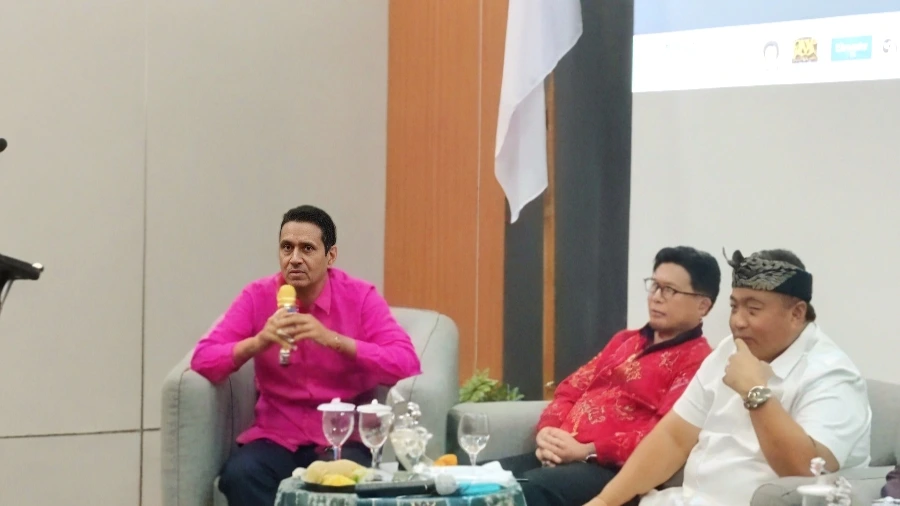
DENPASAR, DEWATA.NEWS – The rapid growth of investment in Bali over recent years has come under scrutiny, as policymakers warn that weak spatial planning is contributing to congestion and unregulated development across the island.
The issue was highlighted by Deputy Secretary of the Bali Regional House Special Committee on Spatial Planning, Assets, and Licensing (TRAP), Dr. Somvir, during a public discussion hosted by the Bali Online Journalists Association (IWO Bali) on Saturday (April 11, 2026).
According to Somvir, total investment entering Bali between 2021 and 2025 reached approximately IDR 123 trillion. However, he noted that the scale of investment has not been matched by effective spatial management.
“If such a large amount of investment had been properly managed, we should not be facing current conditions like traffic congestion and unstructured development,” he said.
He pointed out that traffic congestion has become a visible issue, even affecting official visits. In some cases, alternative routes had to be chosen to avoid delays when accompanying high-level guests.
Beyond infrastructure concerns, Somvir also criticized the slow and inconsistent licensing process. He questioned why certain permits that should have been resolved earlier were delayed until being addressed at the committee level.
“Why are permits that should have been completed long ago only being addressed now at the special committee level? This needs evaluation,” he stated.
Despite these concerns, the TRAP committee expressed support for the current provincial leadership, emphasizing confidence in the government’s role in steering Bali’s development direction.
Somvir added that the committee has prepared comprehensive policy recommendations based on academic studies, involving experts and institutions such as Udayana University. However, he stressed that implementation ultimately depends on both executive and legislative bodies.
“We have prepared comprehensive recommendations. Now it depends on how they are implemented,” he said.
He also emphasized that spatial planning challenges should not be attributed solely to investors or the public, but rather seen as part of broader policy issues that require collective improvement.
For international observers and investors, the discussion reflects a growing focus on balancing economic growth with sustainable urban planning in Bali, as the island continues to attract significant capital inflows.